Immersive Talk with Emika
Can you tell our audience a little about yourself?
I run my own label, Emika Records, and I love to collaborate with all kinds of creative people and spaces – from visual artists to film directors and editors, orchestras, planetariums, DJs and software developers. My music fuses classical, electronic and songwriting. I'm a classically trained pianist, but I abandoned that ship when I was younger to pursue a degree in Creative Music Technology, MAX/MSP Stockhausen and Xenakis. I always believed, if I could have my own studio, that it would be my instrument – the speakers, the room, the whole thing. I've been making music this way since I was 14; I will turn 40 in 2026. I've been figuring it all out, with the help of Mozart, Bach and the ginormous world of composition-as-a-language music, that has been built and established long before me. Now, performing immersive live music and composing immersive music are my two biggest passions.
Can you tell us about your studio space?
The studio is in South Germany in a town called Rottweil, which is in between Stuttgart and Zürich, Switzerland. The area is most famous for the beautiful Black Forest. We're located in an old building in a valley, right next to the river Neckar. After living in and having various studios in Berlin for 17+ years, it feels like one of life's luxuries to have big windows looking out towards the trees reaching to the top of the valley – and to take a break outside and hear the river running past.
At the studio, I do composition, songwriting, albums and mixing, and I produce live shows, music for film and TV, artist residencies, showcases and live streams.
Can you give an overview of the key equipment you use in the studio?
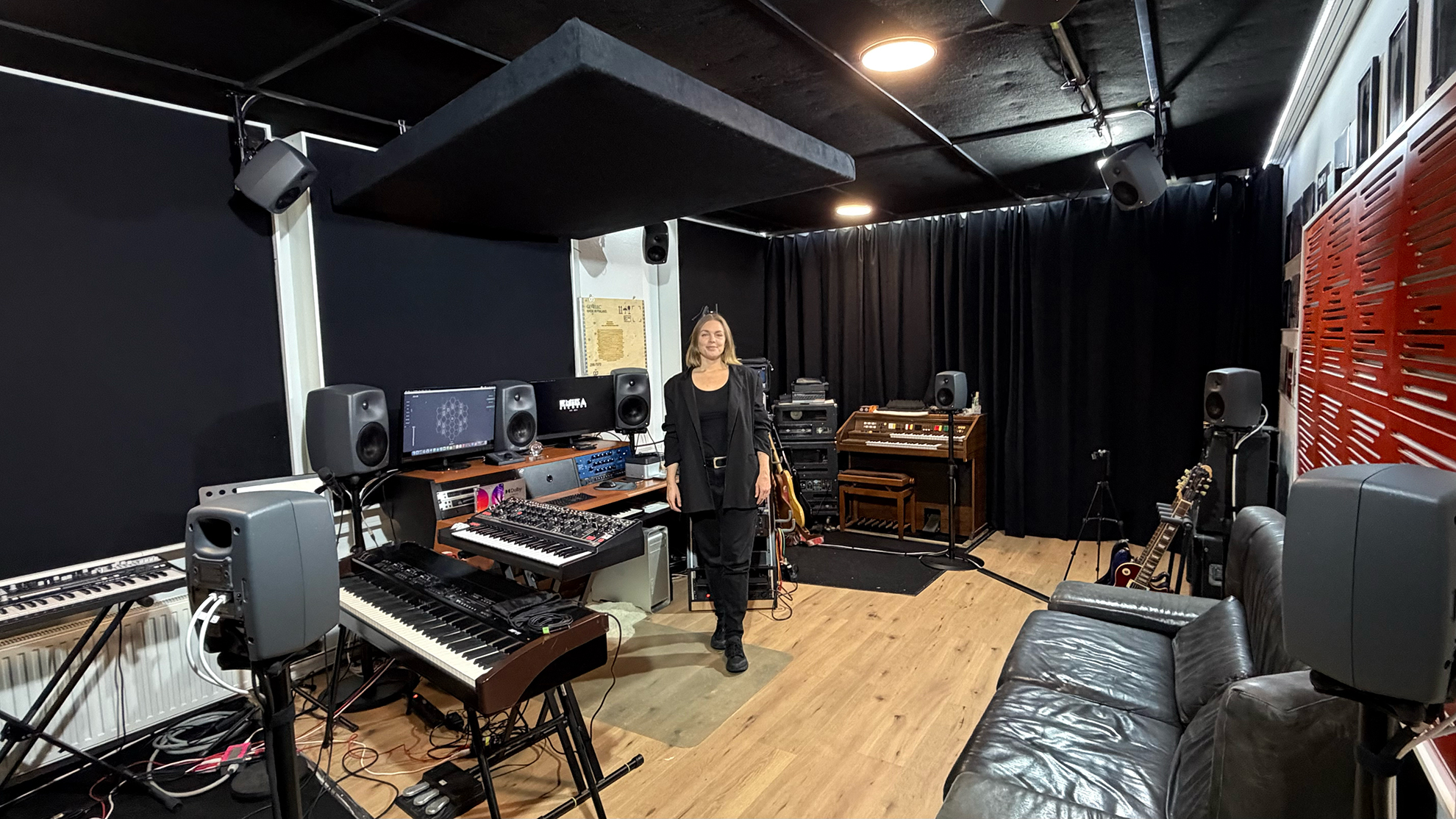
I use a Genelec Smart Active Monitoring (SAM) 7.1.4 system, which comprises of 8350As for LCR, 8330A for surround and height channels, and a 7370A subwoofer. As part of that, I use GLM calibration software, and I extend monitoring to headphones with the Genelec UNIO Personal Reference Monitoring (PRM) system.
Alongside that, there's Dolby Renderer, Apple Mac Studio, Logic, Protools, Ableton, Sibelius, MAX/MSP, Arturia, Eventide, Earthworks Microphones, Kawai Pianos, Tube Tech Compressors and Preamps, RME and Focusrite devices, Neumann Microphones, Moog synths, UDO Synths, Engl and HH Amps, Technics Turn-tables, Pioneer DJ mixers, a MIDAS mixer – and an Electrovoice PA surround setup, because our studio is also a live space for building shows for touring.
How and when did you become interested in immersive audio, and what made you finally upgrade your studio?
Around 2004, when I did my BA in Creative Music Technology, I had the chance to work in surround sound, and that started my journey into the world of immersive music.
For the immersive room build, I did everything with the help of my husband, artist friends, Dolby and Genelec. I did a crowdfunding project on Kickstarter to raise the budget I needed for both the studio upgrade and a new album. The stands, monitors and Genelec software are all built so well, we assembled everything over a single weekend and listened and tested many things, moving my instruments around the space until it all just felt right to make music in. There are many beautiful designs within the world of Genelec and Dolby that require no construction – it's not like IKEA furniture. We still haven't made it pretty. On the other hand, all the pretty studios I've been in have made me want to sit still and not touch anything, sort of the opposite vibe to what I feel I need to be creative in. I don't mind chaos and cable salads. I like to get a vibe going in one big room and making a great sound that way. So maybe it's just fine the way it is, as it sounds absolutely beautiful, with no trouble zones and great mix translation.
Now that you are working in immersive, how does it differ from stereo?
Mixing in stereo – for over a decade now – has always been a game of baking a cake. I add layers, take them away and push sounds around the pot. The pot is the most visible part, so even with a tiny idea and melody that has not found its way, the pot needs to be filled and will always be the most visible part with stereo. It demands that you bake a cake. All little new ideas and sounds must fit into the pot. The sugar brings the sweetness. The butter is heavy part, the eggs bind, and the flour fills it all up.
When you start with a tiny idea and melody in immersive, it very much feels a reflection of the soul. There are no pots, and no eggs. The music can become something very dynamic, fluid, free, limitless. You can make a thousand cakes that can be metaphorical. Things can be implied. Concepts can be presented without needing to be finalised – or forced into a form we can all recognise and hold and taste. You can present only the eggs and butter without making a cake. You can share the experience of baking, and it is this feeling of cooking, of experiencing something coming together, which is delicious, you can swim in the idea of the sweetness that we understand sugar brings.
What keeps you working with Genelec studio monitors?
As a teen, I worked in a music shop selling studio gear, and I first discovered Genelec loudspeakers that way. They have always been in every studio, job and project that I've gravitated towards. It was a while before I could afford my first stereo pair. In my experience with mixing, Genelec studio monitors are the only ones that sound the same everywhere else I listen. I trust them completely. It's horrible to mix music on monitors you can't trust, it's like some kind of slow insanity, pushing plug-ins around, cutting frequencies, like fighting invisible demons. Much better to learn how to trust yourself and develop your own strong musical intuition by working on great monitors.
In a way, I don't really mix at all, I just compose and produce with the Genelecs as my tool, and I know my vision before I start, otherwise I don't start. Producers will always criticise and challenge your work, even if they mean well. Producers tend to think they know the whole and only truth about mixing, and if you in yourself are not sure your mix is any good, it's going to be a really painful struggle to present your work and confidently stand by it.
Did you use Genelec Loudspeaker Manager (GLM) software to calibrate your system?
Yes, we used GLM calibration. We've used it to create different setups in the studio. We've got stereo, 7.1 surround and Dolby Atmos 7.1.4, and it's really simple to switch workflows using GLM. GLM calibration and its phase alignment made it easy to create a great sound and to troubleshoot smoothly.
How is business going for you in the immersive world?
Emika Records Immersive is an extension of my already existing Emika project as an artist and indie label. I was able to crowdfund the project (a second Kickstarter) and raise around 25k EUR from my listeners and fans. The inspiration for developing my studio into an immersive one comes directly from performing live in planetariums across Europe. To be able to grow our studio into a fully built immersive space to work in felt like a very brave and innovative step to take. People, music lovers, they feel it, they love to experience immersive music – something deep, something unusual.
I have always followed my heart and intuition with my music and creativity, and from this I was always able to grow the business, just not in a typical commercial sense. It all connects to my vision and music, which resonate in their own way with listeners around the world. I have never put out any music that I wasn't totally in love with. I also listen to what I make for a very long time before I release it. I appreciate and trust my listeners, and it is very much given back to me, so we continue onwards together. A music business for me is a way of life, living with music. Immersive music for me is very philosophical, now we begin with the real dynamic music, there are many new things to explore and develop on all sides.
How do you see the future of immersive audio over the next few years?
A beautiful global transition towards a new kind of genre of music. A return to nature. And many product developers trying to figure out how to have that one big hit sale with something called immersive on it, alongside marketing teams trying their best to promote something they don't fully understand yet. The mainstream world of music and tech will continue to do great things with all the investments and work being done in this area, and I personally can't wait to get more access to new kinds of music experiences in an affordable way. There is only so much nostalgia we can cling to for 15EUR a month – music subscriptions won't nourish us forever.
Do you want to be featured in our ‘Immersive Talk’ series? If so, just post some pictures of your setup on Instagram using the #GenelecImmersive hashtag. We’ll be keeping a look out for the most interesting setups, so who knows? We may be in touch with you!


